
Reviews
Quote templates with an expiry date: how to keep 2027 pricing valid
How to set, word and enforce a quote expiry date: validity windows by cost type, pricing expiry clauses, and re-quote triggers that keep 2027 pricing valid.
What to take away
- A quote expiry date is a contract term, not a footer. Put the last day the price holds beside the price itself.
- Match the validity window to your worst cost line. Stocked items can hold 90 to 180 days; commodity material cannot.
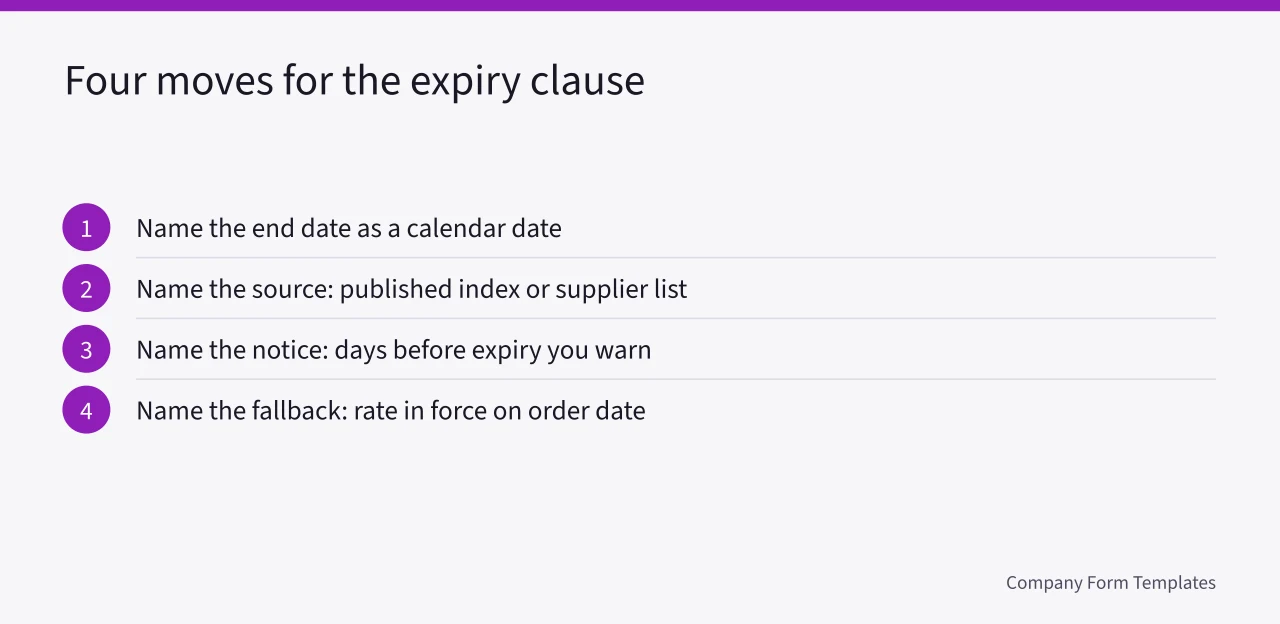
- A pricing expiry clause carries four partsend date, named index or source, notice owed to the client, and the fallback price after expiry.
- Locked pricing works only if the quote template date field is refreshed on every revision, not just the first send.
- Write re-quote triggers before a cost moves, so the next conversation is about the clause rather than goodwill.
An expiry date is a term, not a label
Most quotes fail because nobody recorded the day the figure stopped being true, not because the figure was wrong. A client who receives a price in October and orders in March is holding October costs against March supply. A date in the footer does not resolve that. A term does. A quote template expiry date belongs in the price table, not in a footnote.
The term does two jobs. It protects you when input costs rise, and it gives the buyer a reason to sign before the window closes. A short window reads as a real deadline when it matches the market you buy in.
Set the quote validity period by cost type
How long should a quote be valid depends on the line that moves fastest, not on the average of every line. Use the shortest defensible window for the whole quote, or split the quote into validity bands.
Validity by cost line
Cost line
- Stocked or catalog item
- 90-180 days
- Labour rate
- 12 months
- Freight and fuel surcharge
- 14-30 days
- Commodity material
- 7-30 days
- Imported goods
- 30 days
Typical validity
- Stocked or catalog item
- Supplier price list revision
- Labour rate
- Annual wage review
- Freight and fuel surcharge
- Published fuel index
- Commodity material
- Mill or exchange index
- Imported goods
- Exchange rate band
What resets it
- Stocked or catalog item
- Labour rate
- Freight and fuel surcharge
- Commodity material
- Imported goods
| Cost line | Typical validity | What resets it |
|---|---|---|
| Stocked or catalog item | 90 to 180 days | Supplier price list revision |
| Labour rate | 12 months | Annual wage review |
| Freight and fuel surcharge | 14 to 30 days | Published fuel index |
| Commodity material | 7 to 30 days | Mill or exchange index |
| Imported goods | 30 days | Exchange rate band |
Two lines with different clocks need two expiry notes. A single date at the top of the page says nothing about a freight surcharge that resets monthly.
Write the pricing expiry clause in four moves
- Name the end date as a calendar date, not "30 days from issue", so every reader sees the same deadline.
- Name the source. Tie any reset to a published index or a supplier list you can show the client.
- Name the notice. State how many days before expiry you will warn the client of a change.
- Name the fallback. Say that orders arriving after expiry are priced at the rate in force on the order date.
Public buyers often require an acceptance period on the face of the quote. The Federal Acquisition Regulation Part 13 covers simplified acquisition procedures, where that period governs the award, so mirror the format your buyer uses.
Example: a bracket quote that holds into 2027
Unit price USD 41.20 per bracket, valid through 31 March 2027. Steel surcharge recalculated quarterly against the published mill index. We will notify you 30 days before any change. Orders received after 31 March 2027 are priced at the rate in force on the order date.
The clause is short because each element has one job. A reader can test it with four questions: what date, what index, what notice, and what happens afterwards. That is the same test a procurement officer or auditor applies to your file.
Fields that carry the quote template date field
- Issue date and revision number on every page.
- Expiry date in the header and repeated inside the price table.
- A source note beside each unit cost, with the date the cost was checked.
- Currency, delivery basis, and the quantity band the price assumes.
- The name of the person who approved the pricing, with the approval date.
A quote with these fields survives a follow-up call in 2027 because every figure traces back to a dated source. The walkthrough on how to date and source a quote template so the price still stands in 2027 covers validity windows, source notes and revision control.
Fields that carry the date
- Issue date and revision number on every page
- Expiry date in header and price table
- Source note beside each unit cost, dated
- Currency, delivery basis, quantity band
- Pricing approver name and approval date
A companion guide on quote templates that hold their price covers sourcing and dating for 2027, including the validation steps that keep a figure defensible months later.
The field list that does the most work is the one built to stop a client asking twice, covering scope, exclusions and revision tracking in one place.
If you want the finished shape, a dated, sourced pricing page shows examples with source notes, expiry terms and a review cycle.
Re-quote triggers you write before you need them
A re-quote trigger is an event that voids the quoted price. Put it in the terms, not in a private note. Typical triggers include an index move beyond an agreed percentage, a supplier withdrawing a list price, volume falling below the quoted band, and any change to scope or delivery point.
Locked pricing is not a promise to lose money. It is a promise to hold a figure while the stated conditions hold. When a client accepts, the terms travel into the purchase order, and the standard purchase order elements include the price and delivery date that must match your expiry clause.
A stale quote is also a cash timing problem. The components of a cash flow statement show how a delayed, re-priced order pushes receipts into a later period. A locked pricing quote template should show where a new figure goes and who signs it.